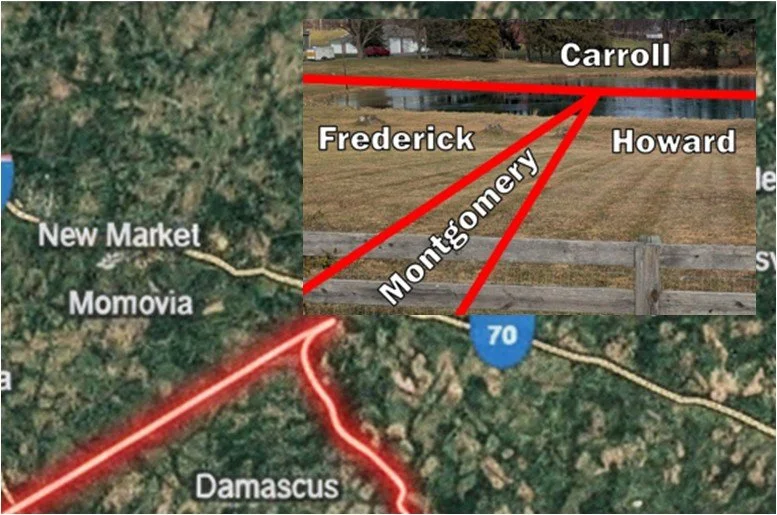
The Tip of Montgomery County: A 250 Year-Old Oddity
The northernmost portion of Montgomery County is a mile-long, sparsely populated, needle-like tip. It varies in width from 100 to 500 feet and culminates at a sharp point in a place known as Four County Farm. A small ranch house on the property embodies the unique geography. Its half-acre Howard County-zoned lot on Lakeview Drive faces Carroll County and contains slivers Montgomery County and Frederick County. Just across the front lawn, under the surface of a small pond, is Maryland’s only quadripoint. This is the precise location where Frederick, Carroll, Howard, and Montgomery counties meet, a little south of Mt. Airy.
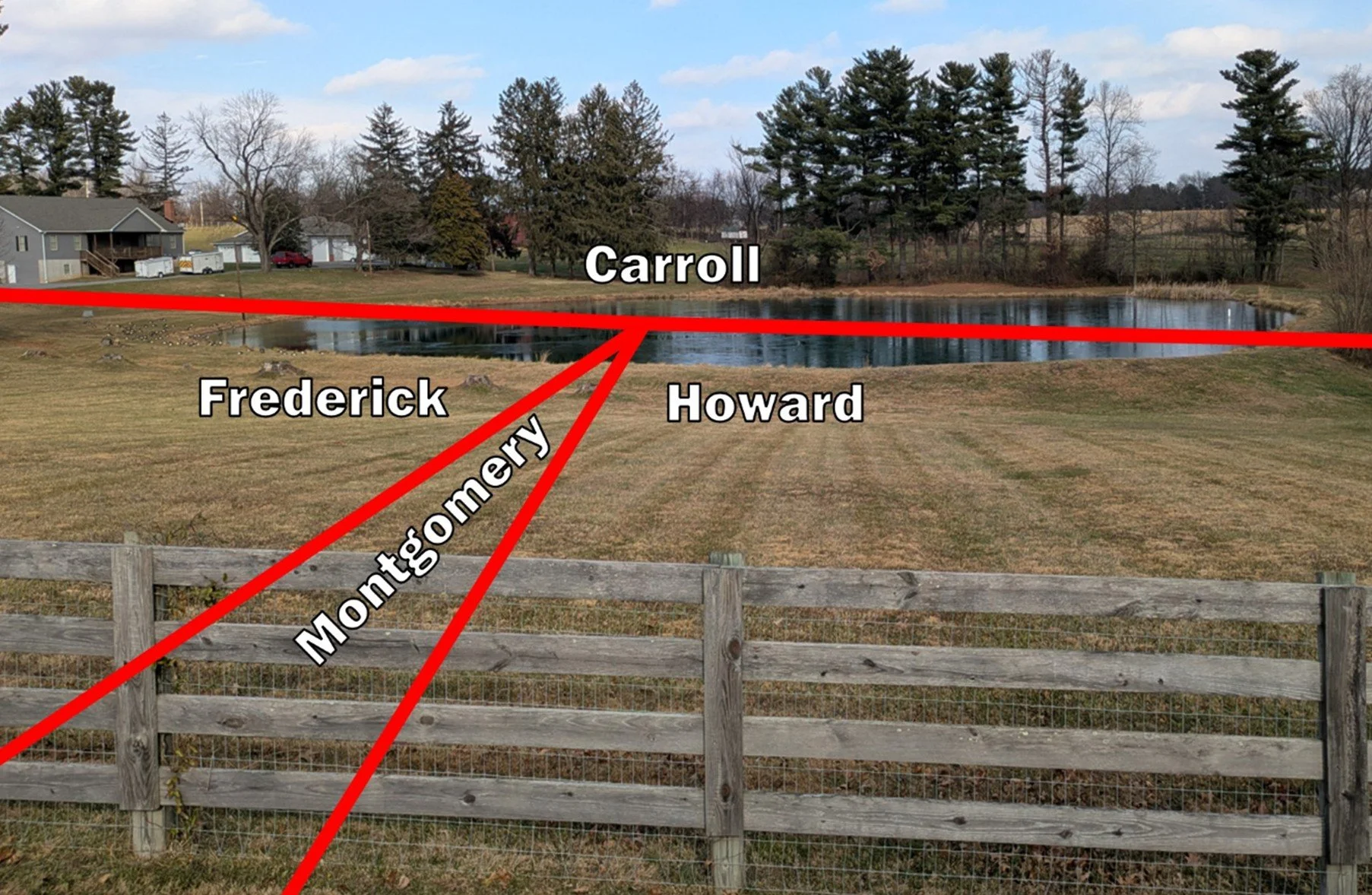
The view from homes on Lakeview Drive, a small street with four homes once part of Four County Farm. Photo Credit: The Montgonion, December 7, 2025.
Origin of the Peculiar Boundary
The reason for Montgomery County’s unusual northern extension dates back to the county’s founding in 1776. Amid the fervor of the American Revolution, delegates at Maryland's Constitutional Convention sought to reorganize the sprawling Frederick County, which had itself been carved from Prince George's County in 1748. They divided Frederick into three parts: Washington County to the west, a reduced Frederick County in the middle, and Montgomery County to the south.
The act establishing Montgomery County explicitly defined its boundaries: "beginning at the east side of the mouth of Rock Creek on Potomac River, and running with the said river to the mouth of Monocacy, then with a straight line to Parr's Spring, from thence with the lines of the county to the beginning."
The straight-line directive from the Monocacy River to Parr's Spring created the elongated, razor-thin tip that has persisted unchanged ever since.
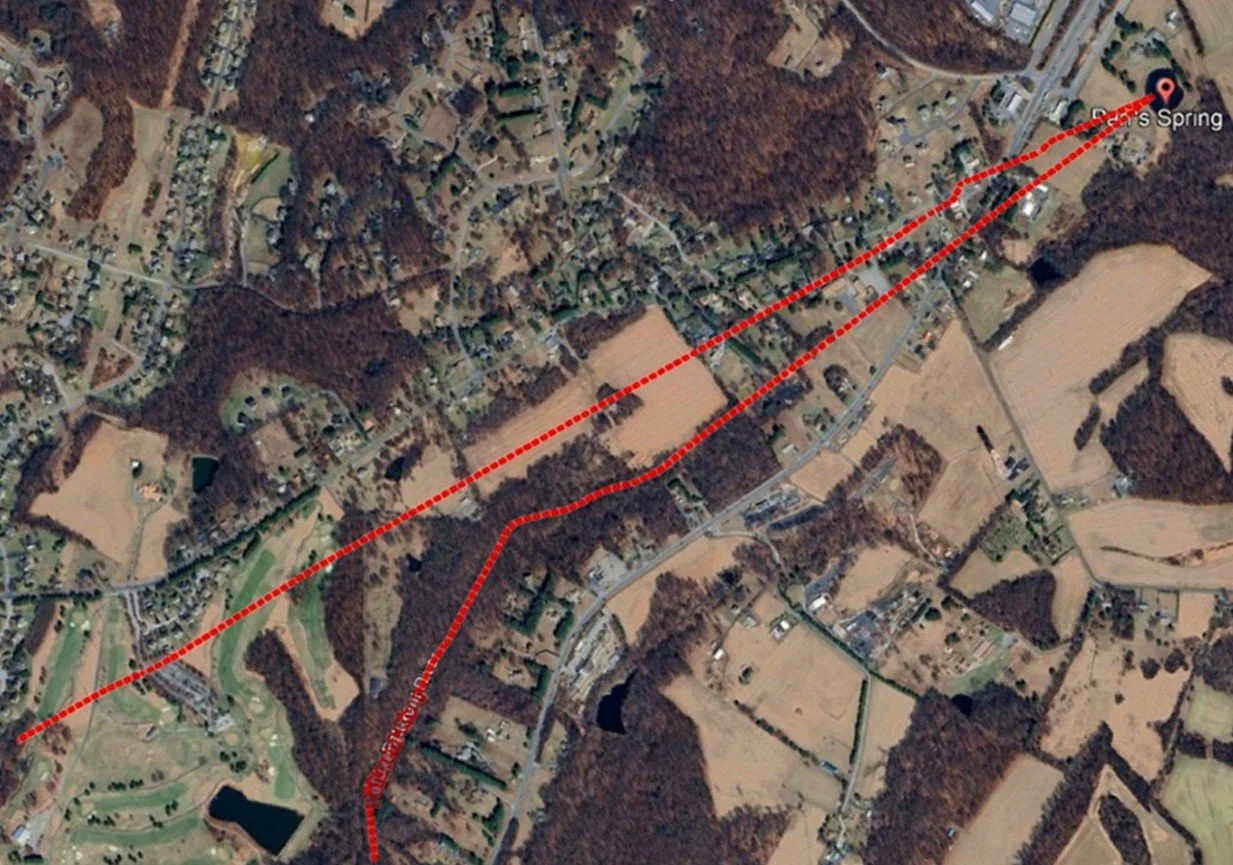
The boundaries of the northern tip of Montgomery County, Maryland, terminating at Parr’s Spring. Photo Credit: Google Earth
The Importance of Parr’s Spring
Parr’s Spring, the source of the Patapsco River, was an established and reliable landmark long before 1776. Named after John Parr, an 18th-century landowner who patented the surrounding area as "Parr's Range" in 1744, the spring appears in land records as early as 1726. At that time, it marked the division between Baltimore and Anne Arundel counties.
By 1748, with the creation of Frederick County, the spring implicitly became a boundary point, a status the Maryland General Assembly made explicit in 1750, clarifying the Frederick-Baltimore line as beginning there. Parr’s Spring's role as the Patapsco River's source made it a natural choice for surveyors, anchoring multiple boundaries as Maryland's county map evolved.
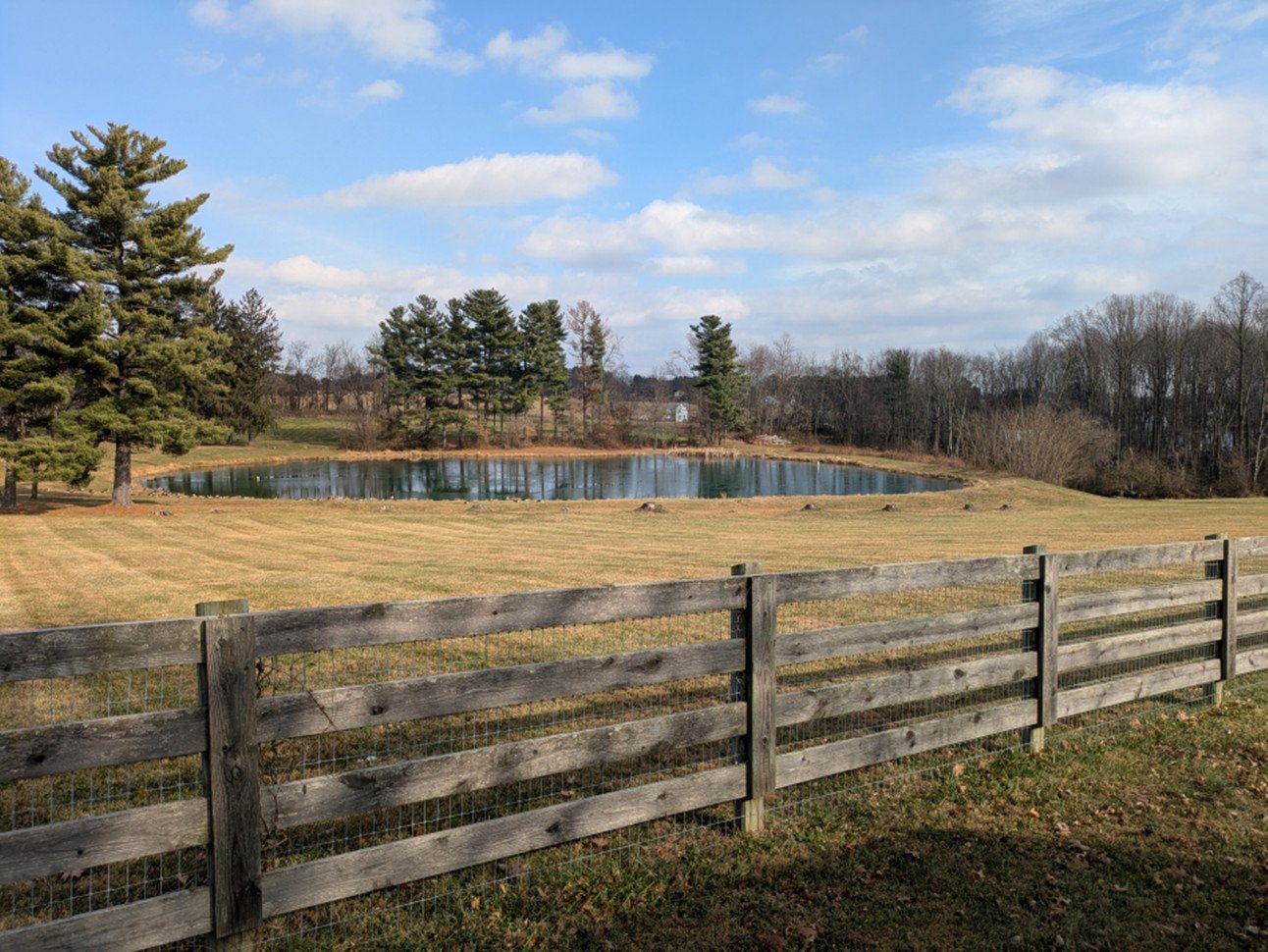
Parr’s Spring is located beneath the surface of this pond on Four County Farm. Photo Credit: The Montgonion, December 7, 2025
The Evolution of a Quadripoint
When Montgomery County was established in 1776, the spring initially served as the meeting point for Montgomery, Frederick, Baltimore, and Anne Arundel counties. The current four-county convergence was solidified by two later adjustments. In 1837, Carroll County was created from portions of Frederick and Baltimore counties, and its boundaries were drawn to pass through Parr's Spring. And in 1851, Howard County was formed from Anne Arundel County, inheriting the northwestern boundary at the spring.
These mid-nineteenth century adjustments transformed what was once a simple spring into Maryland's present-day quadripoint, and sharpened the uniquely shaped northern tip of Montgomery County.
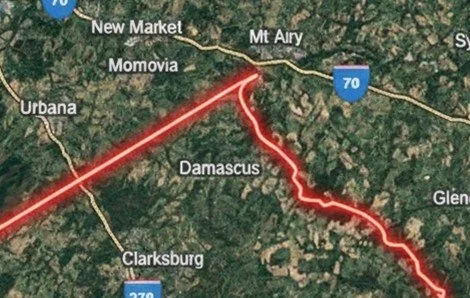
Photo Credit: Google Maps
Enduring Legacy
The boundaries anchored at Parr's Spring have required periodic resurveys to resolve ambiguities. A notable effort in 1834-1835 saw surveyors retrace the line from the Monocacy River's mouth to Parr's Spring, placing or marking eleven stones to affirm the original straight path. A 1980 resurvey by the Maryland Geological Survey further validated the site, correcting misconceptions, including the erroneous belief that it was also the headwaters of the Patuxent River.
Despite the passage of time, the needle-like tip of Montgomery County remains a testament to 18th-century surveying practices. Today, Parr's Spring lies submerged in a pond on privately-owned Four County Farm, marked by a concrete monument and boulders, though access is restricted.
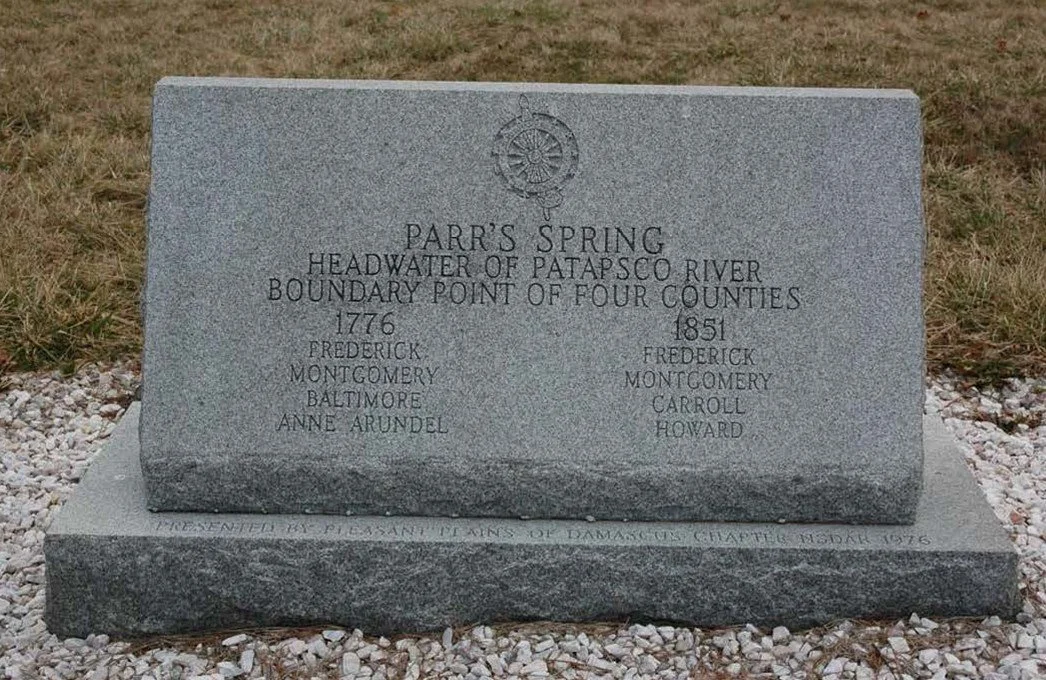
Marker placed by the Pleasant Plains of Damascus Chapter of the Daughters of the American Revolution. Photo Credit: Maryland Historical Trust
The 250-year-old tip of Montgomery County is an oddity that highlights the quirks of historical boundary-making and how natural features like springs and rivers once dictated the geography of governance in early America.
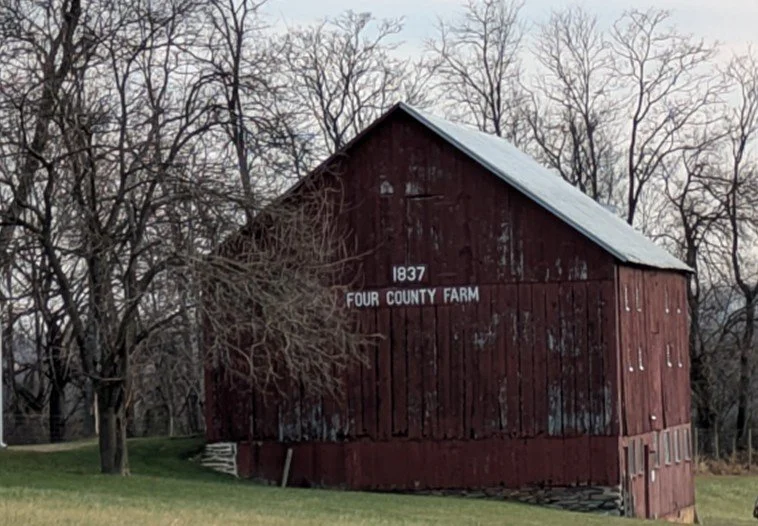
Barn at Four County Farm. Photo Credit: The Montgonion, December 7, 2025
Further Reading
Beneath the pier, 4 counties meet; History: The waters of Parr's Spring near Mount Airy flow over a unique convergence, Baltimore Sun, May 15, 2000
How different parts of Montgomery County used to be divided and named – Greater Greater Washington, September 26, 2018
Maryland's Unique Four-County Crossroads Can Be Found at This Spring – The MocoShow, July 2025
Montgomery County, Maryland: Our History and Government - Montgomery County Historical Society, 1999